The Gatekeeper Who Is Also Trapped: The Irony of System Builders
Abstract
Gatekeepers control the access points and rules of social systems, often modifying them to maximize their own advantage. Yet systemic manipulation carries a hidden cost: the gatekeeper becomes a prisoner of the distrust they cultivate. Their rule-manipulation insulates them from neither the departure of their assets nor the relational consequences of their deceptions.
This essay examines why system builders who rely on deception are ultimately defeated by the relationships they seek to exploit.
I. Introduction: The Equity–Equality Fault Line
Few distinctions in contemporary social discourse generate more heat than the difference between equality and equity. Equality, in its classical liberal formulation, demands that every person be subject to the same rules, the same treatment, the same measure. Equity, by contrast, insists that identical treatment applied to unequal conditions reproduces inequality — that fairness sometimes requires differential investment, adjusted outcomes, and deliberate correction of inherited disadvantage.[4] Both positions appeal to justice. Both carry internal coherence. And yet the debate between them has, paradoxically, become one of the most divisive fault lines in modern public life.
The accusation of double standard is leveled in both directions. Critics of equity argue that adjusted treatment is preferential treatment rebranded; critics of equality argue that formal sameness is a cover for structural indifference. The result is a discursive double bind:[5] any attempt to resolve the equity-equality tension is immediately reframed as evidence of the very bias it claims to correct.
This essay asks whether the structural dynamics of this impasse have appeared before, in other forms, in other eras — and whether those earlier appearances carry any insight into how double binds of this kind are resolved. The answer is that the oldest archetypes of human conflict contain a relational logic that modern policy frameworks have not yet found language to express.
II. Sociological Frameworks: Favoritism, Bias, and the Double Bind
Erving Goffman's concept of facework illuminates why equity interventions so often misfire.[6] When a corrective measure is experienced by its recipient as charity or stigma, it damages the very face it was designed to protect. Redistribution of material resources does not automatically redistribute dignity. Reconciliation requires that both parties emerge from the encounter with their face intact — a condition that purely procedural fairness rarely satisfies.
Pierre Bourdieu's habitus adds a further layer: the ingrained dispositions acquired through social position.[7] Equity policy changes the rules of the game; it does not automatically change the players whose behavior was shaped under the prior rules.
Gregory Bateson's double bind maps directly onto the equity-equality impasse.[5] The disadvantaged party is told simultaneously: you deserve equal treatment and you need differential support to access equality. Each message is reasonable in isolation; together, they construct a trap. The double bind is not a logical failure; it is a relational one — it cannot be resolved by better policy language but requires a different kind of encounter.
Restorative justice theory reframes the central question from what rule was broken? to who was harmed, and how can relationships be repaired?[8] The shift is from procedural fairness to relational repair. The deepest conflicts are not primarily resource conflicts — they are identity conflicts, and identity cannot be redistributed.
III. Historical Case Studies: Reconciliation Under Systemic Inequality
South Africa's Truth and Reconciliation Commission (1996–1998) offered conditional amnesty in exchange for full public disclosure — not procedural fairness, but ritualized truth-telling. Communities which participated in TRC hearings demonstrated measurably higher inter-racial trust, not because injustice was erased, but because it was acknowledged.[9]
Rwanda's gacaca community courts placed survivors and perpetrators in the same village spaces, requiring them to narrate the same events from opposing positions. This relational encounter produced inter-communal trust that punitive international tribunals did not.[10]
Northern Ireland's Good Friday Agreement (1998) combined institutional power-sharing with grassroots contact programs. Structured inter-communal encounter reduced sectarian prejudice independent of legal change. Each party made symbolic concessions carrying real political cost.[11]
The pattern is consistent: reconciliation did not arrive when resources were redistributed equitably. It arrived when symbolic gestures of humility created conditions for mutual recognition. Policy provided the scaffold; relationship-repair provided the substance. The deepest double binds are not solved by better rules — they require a different posture, and that posture cannot be legislated.
IV. The Archetype: Eight Circumstances, One Story
Social science has long recognized that the structures of human conflict are not infinitely varied — the same patterns of favoritism, displacement, grievance, and reconciliation recur across cultures and centuries.[12]
The Gatekeeper sets the rules of marriage and labor, repeatedly modifying them to exploit his son-in-law's productivity. He substitutes brides and changes wages ten times. Yet, his manipulation fails to retain his family or his wealth. He is left pursuing them to a boundary stone, forced to make a treaty of mutual non-aggression. The system builder is ultimately isolated by the very fences he erected.
What this position reveals is that real conflicts resist resolution by redistribution alone. The resolution, when it comes, arrives through a scene of unusual structural simplicity: the most powerful figure in the conflict lowers himself before the one he harmed. The gesture is not an admission of legal liability; it is an act of facework in Goffman's terms — the restoration of dignity without requiring the dispossessed to surrender their grievance.
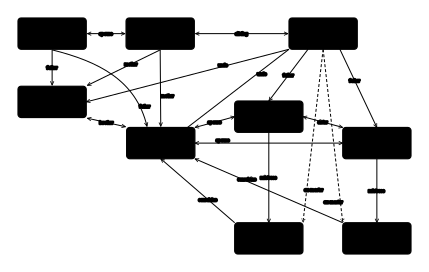
The Source of the Archetype
By this point, the reader may have recognized this figure. He is Laban — brother of Rebekah, father of Leah and Rachel. His story spans Genesis chapters 28–31. We have withheld the attribution until now not as a rhetorical trick, but because the sociological analysis stands independent of the theological claims. The reader who has followed the argument to this point has already accepted the structural logic — the facework, the double bind, the habitus, the restorative encounter — before knowing its source. This is precisely the archetype's most durable quality: it was doing the work of sociology millennia before the discipline had a name.
What the Genesis account adds to the sociological analysis is a claim about origin. The narrative does not present the reconciliation between Jacob and Esau as a diplomatic triumph engineered by clever actors. It presents it as the culmination of a long arc of divine arrangement — including the nocturnal wrestling match in which Jacob's identity is broken and rebuilt, from which he emerges limping but renamed.[22] The transformation that makes reconciliation possible does not arise from within the conflict. It arrives as an encounter with something that transcends the parties.
V. Philosophical Reflection: The Limits of Human Justice
John Rawls proposed the veil of ignorance: design the rules without knowing your position.[23] The elegance is real. So is the limitation: no one actually designs institutions from behind a veil. Every arbiter has a position. Every designer is simultaneously a party to the contest they adjudicate.
This is the Laban problem.[17] The gatekeeper who sets the terms of equity is simultaneously a beneficiary of those terms. He can justify each adjustment individually; the cumulative pattern reveals a systematic preference. The double bind is not incidental; it is structural.
Utilitarian approaches face a mirror problem: aggregate welfare can improve while specific individuals worsen.[24] Utility is not dignity. Communitarian approaches — associated with MacIntyre and Taylor — argue that justice cannot be abstracted from the traditions that give it meaning.[25] This is insightful, but it raises the further question: whose tradition?
The convergence of these three frameworks is suggestive: every coherent theory of justice requires, at some level, a ground truth about human worth and dignity. And every attempt to derive that ground truth from within the system of competing interests it is designed to regulate faces the same recursion problem — the standard being applied is itself a product of the interests it claims to adjudicate.[26]
VI. A Relational Logic Beyond Calculation
If the analysis above is correct, the resolution of the deepest double binds cannot be found within the framework of competing interests they generate. It requires something that enters the conflict from outside the logic of calculation.
The Abrahamic literary corpus returns repeatedly to a particular claim: that the most intractable human conflicts are resolved not when the parties achieve equitable terms, but when one party — typically the more powerful — absorbs the cost of the other's grievance without requiring repayment.[27] In Genesis 33, the powerful one does not negotiate; he bows. He does not offer compensation; he offers recognition. And the grievance, building toward violence for twenty years, dissolves — not because the injustice is undone, but because the person behind the grievance is seen.
In sociological terms, this is the restoration of social capital through a symbolic act that bypasses the transactional logic that had made restoration impossible.[28] The act is asymmetric — in the direction of grace. And it is precisely the asymmetry that makes it work.
The historical case studies in Section III share this logic. The TRC worked because perpetrators absorbed the dignity cost of public confession. Rwanda's gacaca worked because victims were given the structural position of witness rather than merely of sufferer. These asymmetric gestures function by the same logic as Genesis 33.[9, 10]
The tradition that produced this archetype identifies the source of this relational posture — the capacity to absorb cost without requiring repayment — as something human social systems do not generate on their own.[29] We do not require the reader to adopt that claim. We note only that the communities which have produced the most durable reconciliations in the historical record have done so in contexts where some version of this asymmetric relational logic was operative.
VII. Conclusion: Is Equity Without a Ground Truth Just Another Double Standard?
We return to the question with which we began. Is equity just a double bind?
Yes — when it has no ground truth to appeal to. Every equity framework imports assumptions about what fair means, derived from prior commitments about human worth and dignity. When those prior commitments are left unexamined — when fairness is defined entirely within the system of competing interests it is designed to regulate — the definition of equity tends, over time, to migrate toward the interests of those with the power to define it.
The Genesis archetype does not resolve the claims of its eight competing figures by applying a better equity metric. It resolves them by introducing a relational posture — asymmetric, costly, non-transactional — that the existing framework could not have generated. The dispossessed does not receive his inheritance back. The invisible contributor does not receive retrospective recognition. The surrogate mothers receive no formal credit for the tribes their bodies produced. What changes is more fundamental: the character of the relationships, and the possibility of a shared future.[30]
The historical evidence suggests this relational logic is not merely a theological proposition — it is empirically observable. Communities that sustain it produce more durable reconciliations. Communities that exhaust it relapse into the double bind.
This raises a question equity discourse has not yet adequately addressed: Where does the capacity for this relational posture come from? And can it be sustained without reference to something that transcends the parties maintaining it?[31]
We leave that as an open question — not because the answer is unclear, but because the question is most productive when the reader arrives at it themselves. The archetype does not announce its answer. It enacts it. Perhaps that is the most honest thing we can say about where goodness comes from: it is more recognizable in its effects than in its definitions. And its effects look remarkably like what happens when someone absorbs a cost they did not create, to restore a dignity they did not destroy.
The missing variable in modern equity discourse may not be a better algorithm. It may be a better source.
Footnotes
- [1] The framework of "identity conflict" vs. "resource conflict" is central to conflict transformation theory. See John Paul Lederach, The Moral Imagination (2005).
- [2] Cross-case analysis consistently identifies symbolic gesture as the proximate cause of reconciliation breakthroughs, distinct from policy architecture. See Priscilla Hayner, Unspeakable Truths, 2nd ed. (2011).
- [3] Genesis 25:19–33:20. The eight structural positions analyzed in Section IV correspond directly to Leah, Rachel, Esau, Jacob, Laban, Isaac, Rebekah, Bilhah, and Zilpah as rendered in the Masoretic Text.
- [4] For the DEI policy formulation of the equality–equity distinction, see Ibram X. Kendi, How to Be an Antiracist (2019), ch. 2.
- [5] Gregory Bateson et al., "Toward a Theory of Schizophrenia," Behavioral Science 1(4), 1956. Bateson's double bind — conflicting injunctions with no meta-level escape — applies structurally to the equity-equality impasse.
- [6] Erving Goffman, Interaction Ritual (1967). Facework denotes strategies by which actors maintain public self-image (face) during social encounters.
- [7] Pierre Bourdieu, The Logic of Practice, trans. Nice (1990). Habitus: durable dispositions produced by conditions of existence, which generate practices reproducing those conditions.
- [8] Howard Zehr, Changing Lenses (1990); The Little Book of Restorative Justice (2002).
- [9] Desmond Tutu, No Future Without Forgiveness (1999). The TRC's asymmetric design: amnesty granted in exchange for truth, prioritizing relational repair over punitive equity.
- [10] Phil Clark, The Gacaca Courts, Post-Genocide Justice and Reconciliation in Rwanda (2010).
- [11] Ulrike Niens and Ed Cairns, "Contact Theory: Critical Evaluation" (2005).
- [12] René Girard, Violence and the Sacred, trans. Gregory (1977). Rivalry, scapegoating, and reconciliation are structural constants across cultures.
- [13] Leah (Hebrew: לֵאָה, Lē'āh). Genesis 29:31: "the LORD saw that Leah was hated." Mother of Judah (Gen 29:35), the messianic lineage (Matthew 1:3; Revelation 5:5).
- [14] Rachel (Hebrew: רָחֵל, Rāḥēl). Genesis 30:1: "Give me children, or I shall die" — spoken despite being the favored wife.
- [15] Esau (Hebrew: עֵשָׂו, 'Ēśāw). The birthright transaction (Gen 25:29–34) and blessing theft (Gen 27) establish his legal and customary claim. His expected violence structures Genesis 32:6.
- [16] Jacob (Hebrew: יַעֲקֹב, Ya'ăqōḇ, "supplanter"). The Peniel wrestling match (Gen 32:22–32): hip dislocated, renamed Yisrā'ēl ("one who strives with God"), emerges permanently marked.
- [17] Laban (Hebrew: לָבָן, Lāḇān, "white/pure"). Genesis 31:7: "changed my wages ten times." Instantiates the Gatekeeper's structural trap.
- [18] Isaac (Hebrew: יִצְחָק, Yiṣḥāq, "he laughs"). Genesis 27:33: "He trembled violently... he shall be blessed." His refusal to revoke the misdirected blessing suggests recognition — however unwitting — of a larger design operating through his impairment.
- [19] Rebekah (Hebrew: רִבְקָה, Riḇqāh). The divine oracle: Genesis 25:23. Her instructions to Jacob: Genesis 27:8–13. Her assumption of moral cost: "Let your curse be on me, my son" (v.13). Genesis records no further narrative of Rebekah after Jacob's departure (Gen 27:43–45).
- [20] Bilhah (Hebrew: בִּלְהָה, Bilhāh) — Rachel's maidservant; Zilpah (Hebrew: זִלְפָּה, Zilpāh) — Leah's maidservant. The transaction is narrated in Genesis 30:3: "Here is my servant Bilhah; go in to her, so that she may give birth on my behalf, that even I may have children through her." For a theological and ethical analysis of this passage in relation to contemporary surrogacy, see John Grabowski, "Surrogate Motherhood and the Genesis Account," in Scripture and Ethics (2016).
- [21] James K. Hoffmeier, "Bowing to the Ground as a Diplomatic Protocol," JETS 65(3), 2022. Sevenfold prostration (šeba' pe'āmîm) is attested in Amarna-period diplomatic correspondence as formal submission.
- [22] Walter Brueggemann, Genesis, Interpretation commentary (1982). The Peniel episode as identity transformation: Jacob's self-securing habitus is broken as precondition for the subsequent reconciliation.
- [23] John Rawls, A Theory of Justice (1971), §3.
- [24] John Stuart Mill, Utilitarianism (1863); critiqued by Rawls (op. cit.) and Nozick, Anarchy, State, and Utopia (1974).
- [25] Alasdair MacIntyre, Whose Justice? Which Rationality? (1988); Charles Taylor, Sources of the Self (1989).
- [26] Hans Albert, Treatise on Critical Reason (1985). The Münchhausen trilemma applied to equity: any justification of a fairness standard faces infinite regress, circularity, or an arbitrary axiom.
- [27] Romans 5:8: "While we were still sinners, Christ died for us" — the paradigmatic expression of asymmetric cost-absorption in the Abrahamic tradition.
- [28] Robert Putnam, Making Democracy Work (1993). Social capital: networks of trust and reciprocity that facilitate collective action. Symbolic reconciliation gestures function as high-density social capital events.
- [29] Miroslav Volf, Exclusion and Embrace (1996). The "will to embrace" in the face of genuine injury is not humanly generatable from within the conflict; it requires a prior embrace sourced outside — "We love because he first loved us" (1 John 4:19).
- [30] The Shalom concept (Hebrew: שָׁলোֹם, šālôm) — active flourishing of relationships, persons, and community — constitutes a conception of peace that is restorative rather than merely procedural. See Nicholas Wolterstorff, Justice: Rights and Wrongs (2008).
- [31] This is the theological question of grace: whether the capacity for asymmetric, non-transactional reconciliation is self-generated or derived. The Genesis narrative's answer is encoded in the Peniel episode and the divine arrangement of the entire Jacob cycle.
Appendix: Academic and Bibliographical References
I. Sociology of Conflict, Equity, and Reconciliation
- Goffman on Facework
- Goffman, Erving. Interaction Ritual: Essays on Face-to-Face Behavior. New York: Anchor Books, 1967.
- Key: Equity interventions that fail to preserve the face of their recipient can function as aggravated insults, explaining why DEI recognition programs paradoxically deepen resentment.
- Bourdieu on Habitus
- Bourdieu, Pierre. The Logic of Practice. Trans. Nice. Stanford: Stanford UP, 1990.
- Bourdieu, Pierre. Distinction. Trans. Nice. Cambridge, MA: Harvard UP, 1984.
- Key: Structural change in formal rules does not dissolve habitus formed under prior conditions.
- Bateson on the Double Bind
- Bateson, Gregory et al. "Toward a Theory of Schizophrenia." Behavioral Science 1, no. 4 (1956): 251–264.
- Key: Simultaneous demand for identical treatment and differential correction creates a structurally unresolvable injunction.
- Zehr on Restorative Justice
- Zehr, Howard. Changing Lenses. Scottsdale, PA: Herald Press, 1990.
- Zehr, Howard. The Little Book of Restorative Justice. Intercourse, PA: Good Books, 2002.
- Key: Shifts the question from "what punishment fits?" to "who was harmed and how can relationships be repaired?"
II. Historical Case Studies in Post-Conflict Reconciliation
- South Africa TRC
- Tutu, Desmond. No Future Without Forgiveness. New York: Doubleday, 1999.
- Hayner, Priscilla. Unspeakable Truths. 2nd ed. New York: Routledge, 2011.
- Gobodo-Madikizela, Pumla. A Human Being Died That Night. Boston: Houghton Mifflin, 2003.
- Rwanda: Gacaca Courts
- Clark, Phil. The Gacaca Courts, Post-Genocide Justice and Reconciliation in Rwanda. Cambridge: Cambridge UP, 2010.
- Northern Ireland
- Niens, Ulrike, and Ed Cairns. "Conflict, Contact Theory, and Intergroup Forgiveness in Northern Ireland." Journal of Social Issues 61, no. 3 (2005): 509–526.
III. Political Philosophy
- Rawls: A Theory of Justice. Cambridge, MA: Harvard UP, 1971.
- MacIntyre: Whose Justice? Which Rationality? Notre Dame: U of Notre Dame P, 1988.
- Taylor: Sources of the Self. Cambridge, MA: Harvard UP, 1989.
- Albert (Münchhausen Trilemma): Treatise on Critical Reason. Trans. Rorty. Princeton: Princeton UP, 1985.
IV. Biblical Studies: Genesis and Ancient Near Eastern Context
- Primary Text
- Biblia Hebraica Stuttgartensia (BHS). Stuttgart: Deutsche Bibelgesellschaft, 1997.
- Hamilton, Victor P. The Book of Genesis: Chapters 18–50. NICOT. Grand Rapids: Eerdmans, 1995.
- Genesis 33:3 — Diplomatic Prostration
- Bowing to the Ground as a Diplomatic Protocol. JETS 65, no. 3 (2022): 429–445.
- Hebrew: wayyištaḥû 'arṣāh šeba' pe'āmîm (וַיִּשְׁתַּחוּ אַ人亞亞 7 次). Sevenfold prostration formula.
- Genesis 32:22–32 — Peniel
- Brueggemann, Walter. Genesis. Interpretation. Atlanta: John Knox, 1982.
- Fokkelman, J. P. Narrative Art in Genesis. Sheffield: JSOT Press, 1991.
- Hebrew: פְּנִיאֵל (Pənî'ēl, "face of God").
- Leah's Structural Essentiality
- Alter, Robert. The Art of Biblical Narrative. New York: Basic Books, 1981.
- Rebekah's Oracle and Its Cost
- Genesis 25:23 (divine oracle); Genesis 27:8–13 (instruction and moral absorption); Genesis 27:43–45 (Jacob sent away).
- Bilhah, Zilpah, and Surrogacy
- Genesis 30:1–13. Bilhah: bears Dan (דָּן) and Naphtali (נַפְתָּלִי). Zilpah: bears Gad (גָּד) and Asher (אָשֵׁר). Together: four of the twelve tribes.
- Grabowski, John. "Surrogate Motherhood and the Genesis Account," in Scripture and Ethics, ed. Verhey. Grand Rapids: Eerdmans, 2016.
- Volf on the Theology of Embrace
- Volf, Miroslav. Exclusion and Embrace. Nashville: Abingdon, 1996.